

The 3 finger test for TMJ is a quick way to check how far you can comfortably open your mouth. People usually try it after seeing it online, or when their jaw feels tight, clicks, or hurts. To do it, you stack three fingers together and see if they fit between your upper and lower front teeth when you open wide. This test can give you a rough idea of your jaw movement, but it is not a diagnosis. Only a dentist or doctor can tell you what is actually going on.
Table of Contents
ToggleWho Should Try the 3-Finger Test?
You might want to try this test if you have noticed:
- Jaw stiffness
- Clicking or popping when you chew
- Trouble opening your mouth wide
- Frequent jaw or face pain
You do not need symptoms to try it either. Some dentists use it as a simple check during a regular dental visit.
How to Do the 3 Finger Test for TMJ? (Step-by-Step)
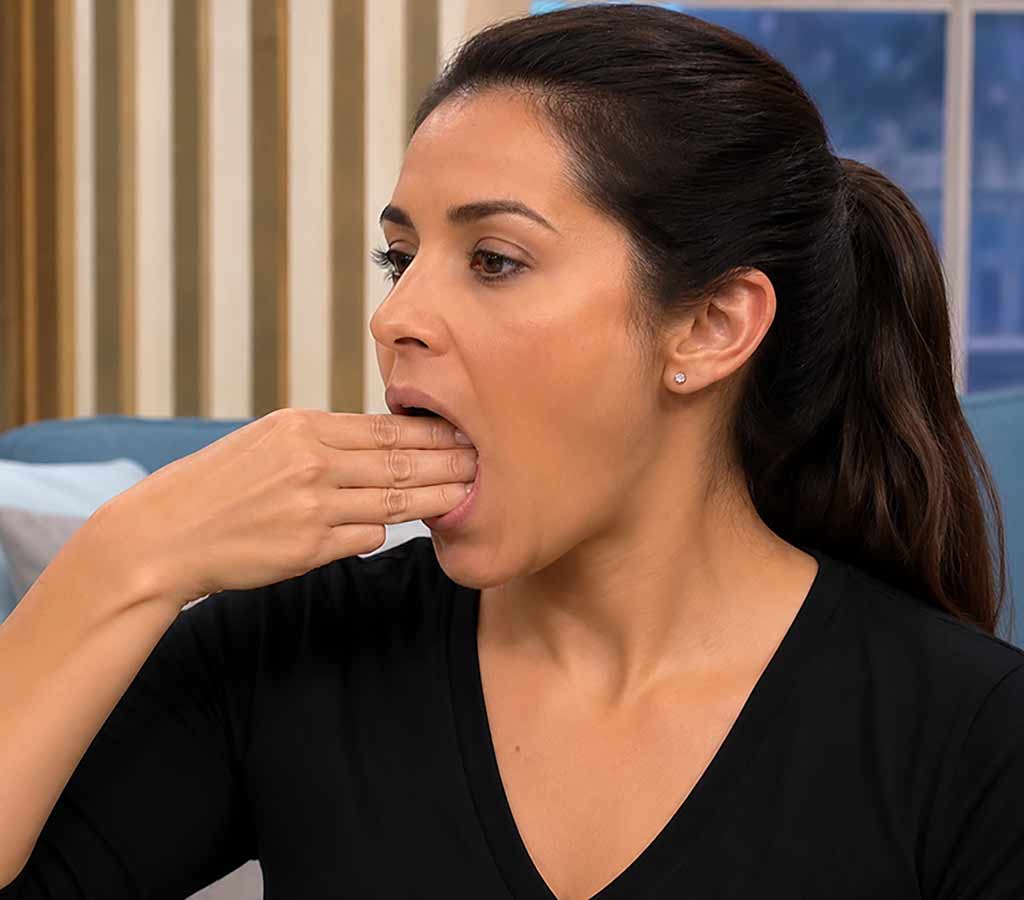
- Relax your jaw completely.
- Stack your index, middle, and ring fingers together, side by side.
- Open your mouth as wide as you comfortably can, without forcing it or pushing through any pain.
- Try to fit the three stacked fingers between your top and bottom front teeth, holding them vertically.
- Notice how many fingers actually fit without pain or strain, and whether your jaw feels tight, uneven, or clicks as you open.
What Your 3-Finger Test Results Mean
Many dental references point to a rough range of about 40 to 60 millimeters for a normal, comfortable mouth opening, with an opening under about 35 millimeters sometimes noted as a possible sign of restriction. These are general guidelines, not exact cutoffs, and only a dentist can tell you where you actually stand.
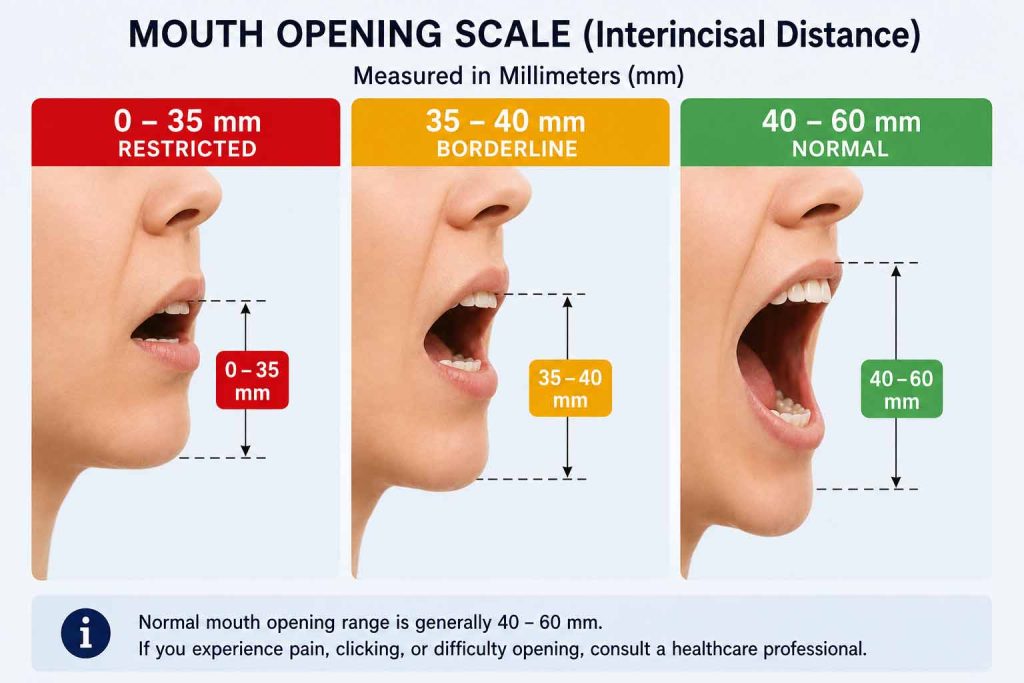
Here is roughly what each result may suggest:
- 3 Fingers Fit Comfortably: This falls in the normal range of motion, roughly 40 to 60 millimeters of opening, so a major mechanical problem in the jaw joint is less likely.
- Only 2 Fingers Fit: This suggests some mild restriction, often from tight jaw muscles, stress-related clenching, or early joint irritation. Keep an eye on it, especially if it comes with clicking or soreness.
- Only 1 Finger Fits: This points to more restriction, sometimes called trismus. It can involve inflammation in the jaw joint, tight or spasming muscles, or the small disc inside the joint shifting out of place. This result is the strongest reason to have a dentist take a closer look.
Remember! The 3-finger TMJ test at home is not an official diagnosis! A smaller opening can come from short-term muscle tension or stress related clenching, not just a lasting joint problem. If your result feels off, treat it as a reason to ask a dentist, not as an answer in itself.
Is the 3 Finger Test for TMJ Accurate?
No, this TMJ self test is not fully accurate. Finger width is different for everyone, so three of your fingers might not match three of someone else’s. That means this test is a rough screening tool, not a real measurement. A dentist or a TMJ doctor checks this properly with a small ruler, measuring the exact distance between your front teeth in millimeters. If you are worried about your result, a real exam is the only way to know for sure.
What Restricted Jaw Opening Could Be a Sign Of
A jaw that will not open all the way has a real medical name: trismus. Trismus means your jaw muscles are too tight or spasming to let your mouth open normally, so the movement feels stuck or limited, not just uncomfortable. It can show up on its own, or alongside jaw pain, clicking, or soreness when you chew. Many dental references use an opening under about 35 millimeters as a rough guideline for trismus, though only an in-person exam can confirm what’s actually going on.
Trismus is not a disease by itself. It is a symptom that can come from a few different sources, including:
- Tight muscles or spasms from grinding or clenching your teeth
- Inflammation or arthritis inside the jaw joint
- Problems with the small disc that cushions the jaw joint
- A dental infection
- Healing after a recent dental or oral procedure
The Challenges of TMJ
TMJ disorders can come from muscle tension, joint inflammation, a shifted disc, or arthritis. Common symptoms include:
- Jaw pain or tenderness
- Clicking, popping, or grinding sounds
- Trouble opening your mouth all the way
- Headaches or neck pain
- Ear pressure or ringing
Your jaw is involved in eating, talking, and sleeping, so even a mild TMJ problem can affect daily life more than people expect. This is part of why TMJ can feel so frustrating to deal with.
What Should You Do If You Can’t Pass the Test?
If you do not pass the TMJ 3 finger test, try not to worry. It does not mean something serious is wrong. It is simply a sign that a closer look from a dentist is a good idea.
Home Care & Conservative Options
Many mild cases improve with simple changes, such as:
- Eating softer foods for a few days, like yogurt, scrambled eggs, mashed potatoes, soup, or smoothies
- Applying a warm or cold compress to the jaw for about 15 to 20 minutes at a time, a few times a day
- Avoiding gum and hard or chewy foods, like ice, hard candy, tough meat, raw carrots, or bagels
- Gentle jaw stretches
- Managing stress, since clenching often gets worse under stress
Two simple stretches to try:
- Relaxed opening: Slowly open your mouth about halfway, hold for a few seconds, then close. Repeat 5 to 6 times.
- Side-to-side stretch: Gently move your lower jaw a small distance side to side, hold briefly, then relax. Repeat a few times.
Stop right away if either one causes pain, and check with a dentist before trying these if your jaw is locked, swollen, or very painful.
Professional Dental Evaluations
If symptoms stick around, a general dentist can check things a home test cannot, like your bite alignment, muscle tenderness, and how your jaw joint actually moves. Depending on what they find, treatment may include jaw exercises, a custom night guard, bite adjustments, or other conservative options your dentist can walk you through.
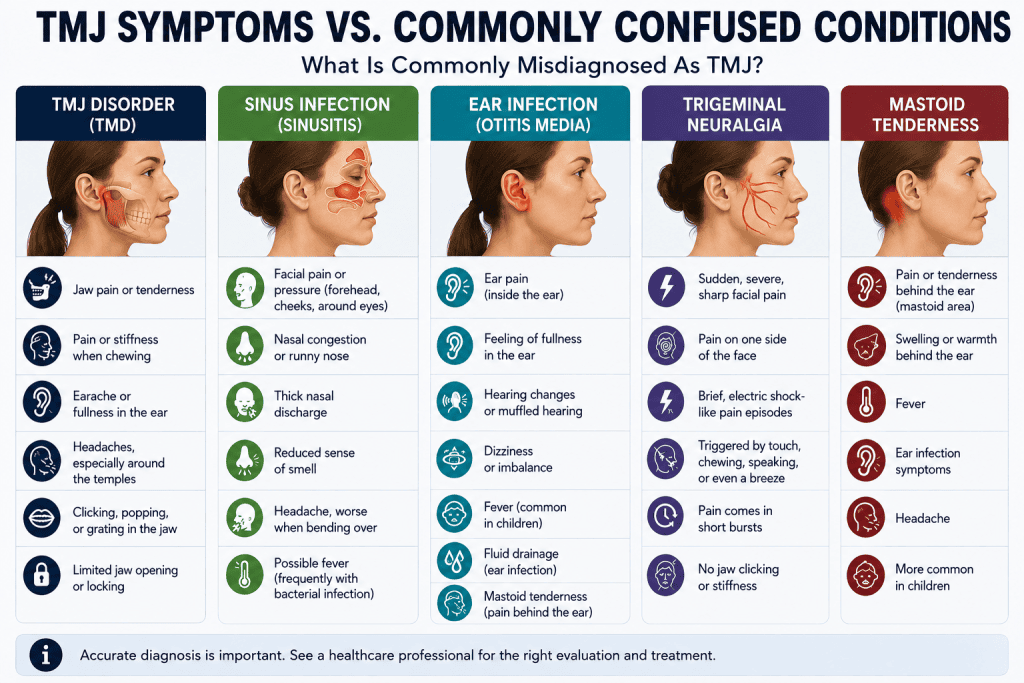
What Gets Mistaken for TMJ Disorder?
TMJ symptoms can look a lot like other health issues, which is why a real exam matters.
Sinus and Ear Infections
Sinus pressure and ear infections can cause pain near the jaw and ear, since these areas sit close together and often share overlapping nerve pathways and symptoms.
Mastoid Tenderness
The mastoid is the bony bump behind your ear. Tenderness or soreness when you press on it can point toward an ear infection or inflammation instead of a jaw joint problem, since TMJ pain usually centers more around the jaw itself and does not typically cause tenderness in that specific spot.
Dental Infections & Toothaches
A severe toothache can cause pain that spreads to the jaw and face, often from an infected tooth or abscess, which is easy to mistake for a jaw joint problem like TMJ.
Trigeminal Neuralgia & Tension Headaches
Nerve pain conditions like trigeminal neuralgia, along with ordinary tension headaches, can also cause jaw and face discomfort that overlaps with TMJ symptoms. Rheumatoid arthritis can affect the jaw joint too and cause TMJ-like symptoms in some people. Telling these conditions apart is exactly why a home test is not enough on its own.
When to See a Dentist or Doctor About Jaw Pain
As mentioned, the 3 finger test for TMJ is not accurate. So, call a dentist or doctor if you notice any of the following:
- Jaw pain or restricted opening that has not improved after a couple of weeks
- Your jaw locking or getting stuck open or closed
- Pain along with fever, swelling, or a clear dental infection, or other dental emergencies
- Numbness, or symptoms only on one side of your face
During a real evaluation, a dentist checks how your jaw moves, feels for muscle tenderness, and looks at your bite and joint function. Imaging may be used if needed. Treatment depends on the cause and can include a night guard, bite adjustments, physical therapy exercises, or other conservative steps your dentist recommends for your case.
TMJ Care at Desert Lake Family Dentistry
The 3 finger test is a helpful starting point, not a final answer. If your results seem off, or your jaw pain, clicking, or stiffness sticks around, it is worth having it looked at properly.
Desert Lake Family Dentistry checks for jaw pain and TMJ symptoms as part of a routine dental exam in Avondale, AZ. So before you Google “TMJ specialists near me”, call 623-388-5888 or book a visit at 10750 W McDowell Rd, Suite B200, Avondale, AZ 85392 to get your jaw checked.
FAQs
What does the 3 finger test for TMJ involve?
Stack three fingers, relax your jaw, open as wide as comfortable, and check if the fingers fit between your front teeth.
What does it mean if only two fingers fit?
It suggests a more restricted jaw opening, possibly from tight muscles or early joint trouble. Worth mentioning to a dentist, not a diagnosis.
Does TMJ ever fully go away?
It depends. Mild, stress-related cases often ease within weeks. Others need treatment like a night guard or physical therapy.
What should I do if I fail the 3 finger test for TMJ?
Don’t panic. It doesn’t confirm a diagnosis alone. It’s a reasonable reason to have a dentist check your bite and jaw.
What autoimmune disease is associated with TMJ?
Rheumatoid arthritis can affect the jaw joint and cause TMJ-like symptoms. Only a doctor can diagnose this.
Why is the 3 finger test important for TMJ issues?
It’s a quick, free way to notice restricted jaw movement early, before it affects eating, speaking, or sleep.
Can anyone do the TMJ 3 finger test at home?
Yes. It takes no equipment and about a minute. Results vary by hand size, so treat it as a rough guide.
References
- American Association of Oral and Maxillofacial Surgeons. TMJ (Temporomandibular Joint) Disorders. aaoms.org
- Cleveland Clinic. TMJ Disorders: Symptoms, Causes, and Treatment. my.clevelandclinic.org
- Mayo Clinic. TMJ Disorders: Diagnosis and Treatment. mayoclinic.org
- National Institute of Dental and Craniofacial Research. TMJ (Temporomandibular Joint and Muscle Disorders). nidcr.nih.gov
- Arthritis Foundation. Rheumatoid Arthritis and Jaw Pain. arthritis.org